🧠 Building a Research Assistant with AI:
From Tool to Platform
🚩 The Challenge
I set out to solve a simple but common problem:"How can I make research faster, smarter, and less painful when working with long academic or technical documents?"
The original idea was to build a lightweight tool for summarizing PDFs using GPT. But the project quickly evolved into something more—a modular, extensible AI-powered research assistant that supports multiple formats, automates citation handling, and exports professional summaries with just a few clicks.
🔧 The Solution
I built a full-featured AI-powered web app using Streamlit that integrates:- 🧾 PDF and TXT file uploads
- 🌐 URL processing for online articles or PDFs
- 🤖 GPT-4 Turbo summarization (multiple styles)
- 📚 Citation detection and formatting (APA, MLA)
- 🧠 Topic detection
- 📤 Export to TXT, PDF, Markdown, HTML, BibTeX, CSV, and JSON
- 🔐 Local login system (with future encrypted database support)
- 🧪 Batch file processing
- 📁 Timestamped outputs and in-app previews
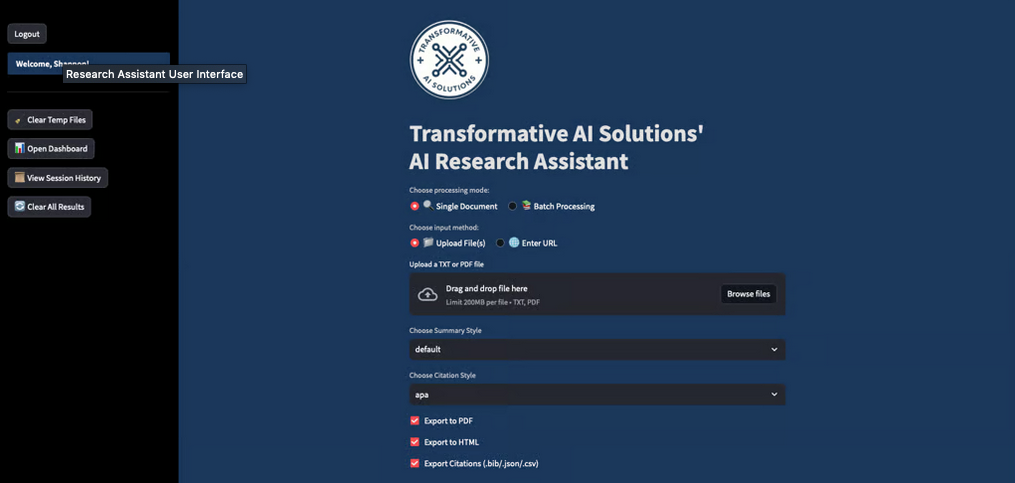
🔍 Feature Highlights
✨ Smart Summaries
Users can choose summary styles, reprocess specific sections, or ask the assistant to "Explain this further."📑 Citation Wizard
The assistant detects in-text citations, fetches metadata via DOI/URL, and reformats them into APA or MLA automatically.📂 Batch Processing
Upload multiple files at once (coming soon with progress bar support). Each document is summarized and cited separately.📤 Flexible Exporting
Users can export results to multiple formats with a single click. File names are automatically timestamped for easy organization.🧱 The Stack
Core Tools
- Streamlit for the interface
- OpenAI GPT-4 Turbo for summarization and explanations
- pdfplumber, PyPDF2, and BeautifulSoup4 for parsing
- fpdf for PDF export
- YAML + streamlit-authenticator for login and user config (Temporary, Soon to be replaced with SQLite)
- Custom Python utilities for citation parsing, formatting, and file management
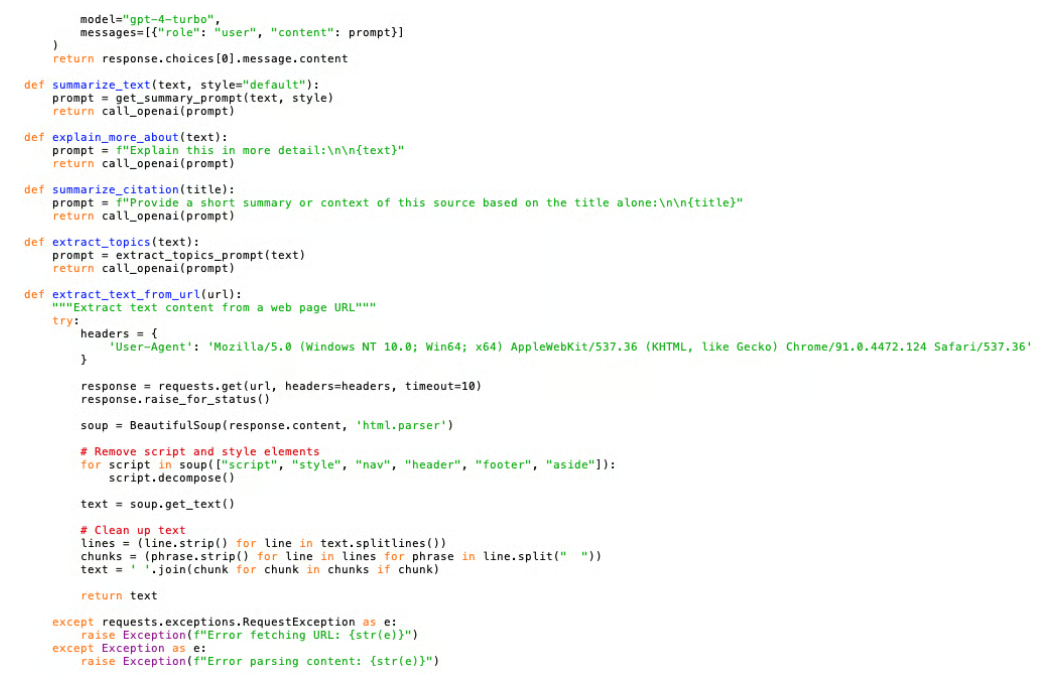
💡 Technical Decisions That Paid Off
- Modularity: I kept the codebase clean by separating citation logic, export utilities, and AI interaction modules.
- Scalability-first: Even before SaaS considerations, I built with growth in mind—batch processing, export options, and file management all scale well.
- User-first UX: I prioritized ease of use: checkbox controls, file previews, and download buttons make this accessible to non-technical users.
📈 Impact & Use Cases
- While it started as a personal project, the app has real potential for:
- Students writing annotated bibliographies
- Researchers conducting literature reviews
- Consultants extracting insights from dense technical or industry reports
- Writers and journalists summarizing long-form research
🚀 What’s Next?
- I'm preparing the app for a potential SaaS offering. Future additions include:
- ✅ Encrypted database for user sessions & projects
- ✅ Project save/load features
- 🌍 Multilingual summarization
- 📊 Visual dashboards and infographics
- 🧩 Prompt customization
- 📋 End-to-end research project workflow support
💼 Work With Me
- This project is just one example of how AI tools—when applied thoughtfully—can solve real-world workflow problems.
- Research-heavy organization
- Educational platform
- Knowledge-based consultant or analyst
- Startup building custom AI workflows
- Experienced Python Coder
If you're a:
💬 Let’s Talk About AI Solutions
 |
Click Here to Download PDF of the Above Case Study |